Short answer: in construction, RFI usually stands for Request for Information. It is a formal, numbered question the contractor sends to the designer or consultant when drawings or specifications are unclear, missing information or in conflict. The answer becomes part of the project record. On some projects, especially in the Gulf, "RFI" is also used for Request for Inspection, which is the same as a WIR, so always check your project's procedure.
RFI meaning and when to raise one
A Request for Information is the contractor's official way to ask a technical question. It protects everyone: the contractor gets a written answer before building, and the designer gets the chance to correct a problem before it becomes rework.
Typical reasons to raise an RFI:
- Conflict between drawings, for example the structural and architectural drawings show different opening sizes.
- Missing information: a detail, level or dimension is not shown anywhere.
- Specification unclear or referring to a product that is no longer available.
- Site conditions differ from the drawings, such as an existing service in the way.
- Constructability: the detail as drawn cannot practically be built, and the contractor wants to propose an alternative.
Not an RFI: requests for approval of a product (that is a MAR), shop drawings (a submittal), or a change in scope that the client wants (that is a variation). Keep RFIs for genuine technical questions.
What a good RFI contains
| Field | What to write |
|---|---|
| RFI number and date | From the RFI log, e.g. PRJ-RFI-STR-0021. |
| From / to | Contractor and the party who must answer (consultant, designer, MEP engineer). |
| Discipline and subject | A short subject anyone can search later: "Level 3 slab: opening size conflict at grid C/4". |
| References | Drawing numbers with revisions, specification section, previous RFIs. |
| Location | Building, level, grids or rooms. |
| Question | One clear question, with the facts. Marked-up drawing or photo attached. |
| Proposed solution | Optional, but speeds things up: "We propose to follow drawing A-301 Rev B." |
| Response needed by | The date the answer is needed to avoid delay. |
| Possible impact | Time, cost, quality, safety or none. |
| Response | The consultant's or designer's answer, name, signature and date. |
You can download a free RFI template in Word, Excel and PDF with all these fields.
The RFI process
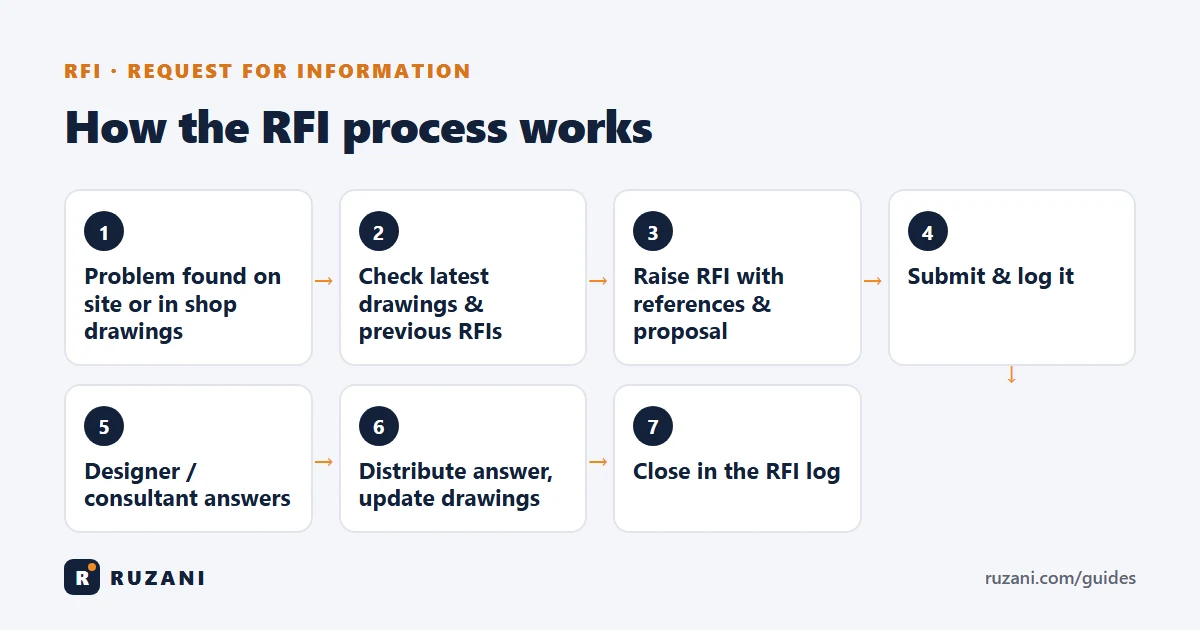
- Problem found on site or during shop drawing preparation.
- Check first that the answer is not already in the latest drawings, specifications or previous RFIs.
- Raise the RFI with references, marked-up drawing and a proposed solution.
- Submit and log it through the document controller, with a transmittal.
- Consultant / designer answers, usually within the period set in the contract.
- Distribute the answer to the site team and update drawings or shop drawings if needed.
- Close it in the RFI log. If the answer changes cost or time, it may lead to a site instruction or variation.
RFI vs WIR
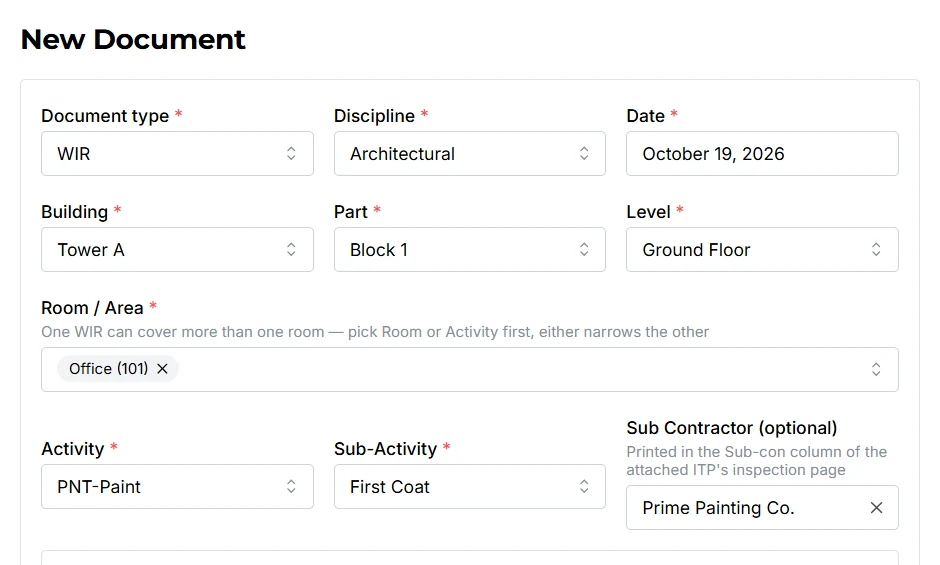
Most projects use RFI for questions and WIR for inspections. Some projects use "RFI" for both, or call the inspection form an "IR". If the document control procedure says RFI = Request for Inspection, follow it, but the content of the form is then the same as a Work Inspection Request.
| RFI (Request for Information) | WIR (Work Inspection Request) | |
|---|---|---|
| Purpose | Ask a technical question | Ask for inspection of completed work |
| When | Before or during the work, when something is unclear | After the work is done, before it is covered |
| Answered by | Designer / consultant | Consultant's inspector on site |
| Result | A written answer or clarification | Status A / B / C / D |
See how all project documents fit together in QA/QC documents in construction.
How to write RFIs that get fast answers
- One question per RFI. Several questions in one RFI get partial answers and stay open for weeks.
- Be specific: drawing number and revision, grid lines, dimensions. Attach a marked-up drawing.
- Propose a solution. "Please confirm we can use detail 5 on A-501" is answered faster than "please advise".
- Give a real "needed by" date linked to the programme, not "urgent" on everything.
- Keep an RFI log with status and days open, and review open RFIs every week. Our free registers workbook can be adapted for this.
FAQ
What is the full form of RFI in construction?
RFI usually means Request for Information. On some projects it is also used for Request for Inspection, which is the same as a WIR.
Who answers an RFI?
The consultant or the designer responsible for the discipline, such as the structural or MEP engineer. The contractor raises it and the document controller submits and tracks it.
How long does an RFI take to answer?
The contract usually sets a response period, often around 7 days. Complex RFIs that need redesign can take longer, which is why the "needed by" date matters.
Can an RFI lead to a variation?
Yes. If the answer changes the work, cost or time, the contractor should notify it in line with the contract, usually through a site instruction or variation request.