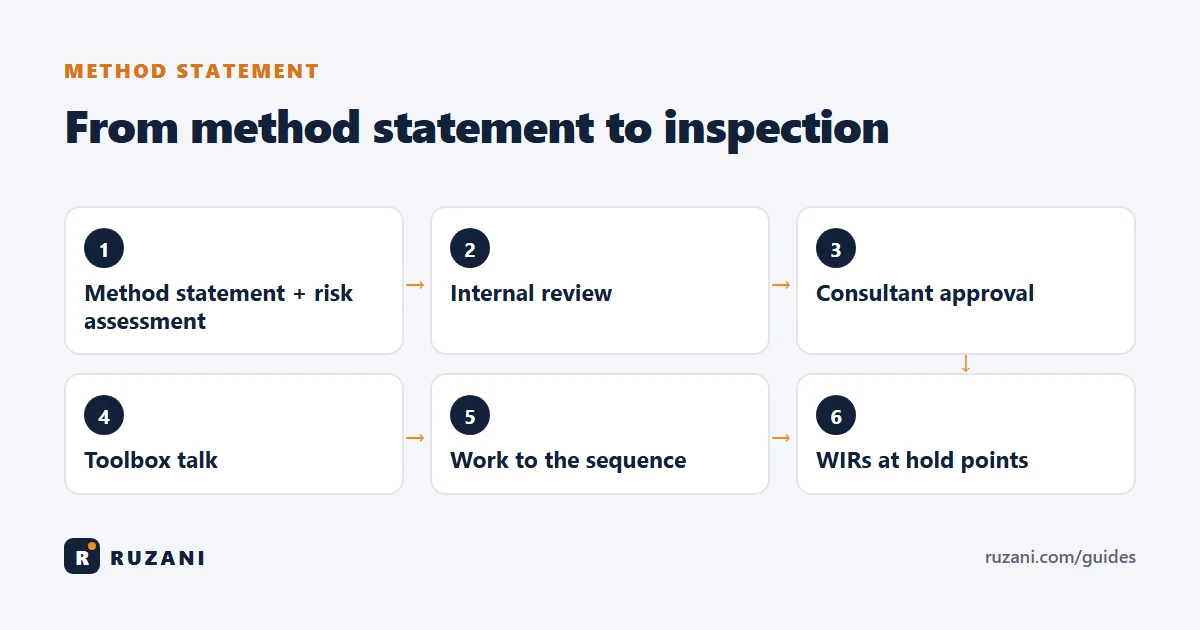
Short answer: a method statement (MS) describes, step by step, how a specific construction activity will be done safely and to the required quality. The standard format has these sections: purpose and scope, references, definitions, responsibilities, resources (manpower, equipment, materials), sequence of work, quality control (ITP), health and safety (risk assessment / JSA), environment, and attachments. On Gulf projects it is submitted to the consultant for approval before the activity starts, usually with its risk assessment and ITP.
What a method statement is for
The specification says what the result must be. The method statement says how the contractor will get there: in what order, with which people and equipment, with which checks, and how risks will be controlled. It is used by the consultant to approve the approach, and by the site team as a working document, often briefed in a toolbox talk to everyone involved.
Method statements are usually needed for each major activity: excavation and shoring, piling, concrete works, blockwork, plastering, waterproofing, tiling, false ceilings, MEP installations, testing and commissioning, and anything with high safety risk such as lifting or working at height.
Method statement format: 12 sections
Exact headings vary, but most consultants in the Gulf expect these:
- Cover page: project, MS number and revision, activity title, prepared / reviewed / approved by, date.
- Purpose: one or two sentences on what the MS covers.
- Scope: which areas, buildings or elements are included and excluded.
- References: drawings, specification sections, approved MARs and shop drawings, standards, manufacturer's instructions.
- Definitions and abbreviations.
- Responsibilities: project manager, site engineer, foreman, QA/QC engineer, HSE officer, subcontractor.
- Resources: manpower, plant and equipment (with certificates where needed), tools, materials.
- Sequence of work: the numbered steps, from preparation to completion, including hold points.
- Quality control: the inspections and tests, referring to the ITP and checklists, and the WIR / MIR process.
- Health and safety: main hazards and controls, PPE, permits, emergency arrangements; full detail in the risk assessment.
- Environmental controls: waste, dust, noise, spills.
- Attachments: risk assessment, job safety analysis (JSA), ITP, checklists, drawings, equipment certificates.
Worked example: blockwork
A shortened example of the most important section, the sequence of work, for internal concrete blockwork:
- Preparation: confirm approved MAR and MIR for blocks, mortar and wall ties; check the approved shop drawing or layout for wall positions and openings.
- Setting out: surveyor marks wall lines and openings on the slab; the QA/QC engineer checks against the drawing.
- Surface preparation: clean the slab, and apply a DPC or bonding layer where specified.
- First course: lay the first course on a full mortar bed, checking line and level. Many projects make this a hold point (WIR for setting out and first course).
- Building up: lay blocks in stretcher bond with joints of the specified thickness; fix wall ties to columns at the specified spacing; check plumb and level regularly.
- Lintels and openings: install precast or cast-in-place lintels with the specified bearing on each side.
- Top of wall: leave the specified gap below the slab or beam and fill with the approved compressible or fire-rated material.
- MEP coordination: chases and sleeves only as approved, before plaster.
- Curing and protection: keep mortar damp as required; protect from impact.
- Final inspection: internal check, then WIR for completed blockwork before plastering.
Then the quality section lists the checks (line, level, plumb, joints, ties, lintels) with tolerances from the specification, and points to the ITP for blockwork.
Risk assessment and JSA
In Saudi Arabia and the Gulf, consultants and client HSE teams normally require a risk assessment with the method statement. It lists each hazard (for blockwork: working at height on scaffolds, manual handling of blocks, cuts, dust from cutting, falling objects), who may be harmed, the risk rating before controls, the controls, and the remaining risk.
A Job Safety Analysis (JSA) breaks the work into steps and lists the hazards and controls for each step. Some projects combine both; follow your project's HSE plan.
Hot climate: for outdoor work in the Gulf summer, include heat stress controls: water and shade, rest breaks, and the midday work ban periods required by local regulations.
How it links to the ITP and WIRs
The method statement, the ITP and the WIRs work as a set:
- The method statement says how the work is done and refers to the ITP.
- The ITP says what is checked and which steps are hold points.
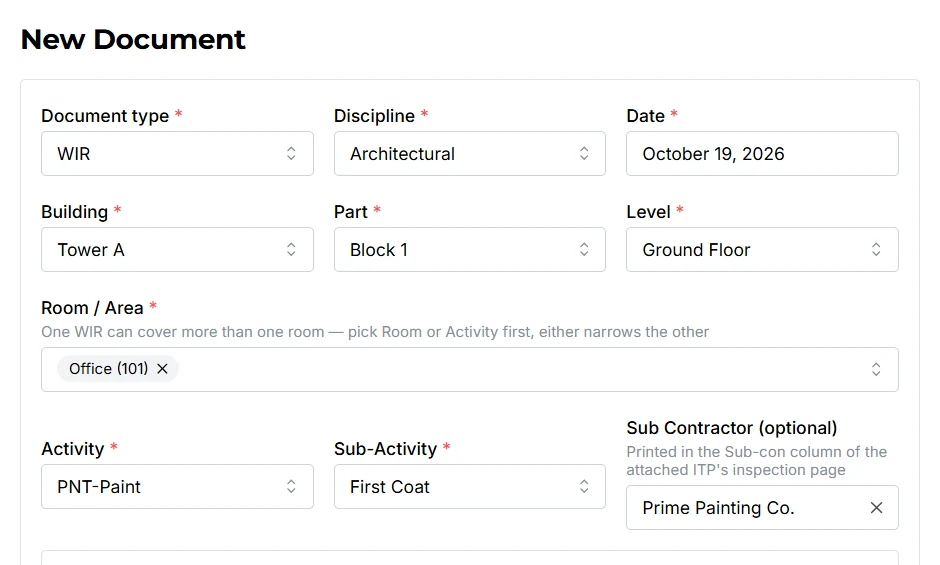
- Each hold point becomes a WIR, which refers to both the ITP and the method statement.
A WIR for work without an approved method statement is often rejected straight away. See the full chain in QA/QC documents in construction.
Tips to get it approved first time
- Write for this project, not a copy from another one. Reviewers spot wrong project names and specification sections immediately.
- Reference approved documents: MAR numbers, shop drawings with revisions.
- Make the sequence concrete: numbered steps, with tolerances and hold points.
- Include equipment certificates for cranes, lifting gear and scaffolds.
- Answer previous comments on resubmission with a comment-response sheet. See approval codes explained.
FAQ
What is a method statement in construction?
A document that explains step by step how a construction activity will be carried out safely and to the required quality, including resources, sequence, quality checks and safety controls.
Who prepares the method statement?
The contractor's engineer for the activity, usually with input from the QA/QC engineer and HSE officer. It is reviewed internally and then submitted to the consultant for approval.
What is the difference between a method statement and a risk assessment?
The method statement describes how the work is done. The risk assessment identifies the hazards of that work and the controls. They are usually submitted together.
Is a method statement the same as an ITP?
No. The method statement describes the procedure; the ITP lists the inspections and tests with acceptance criteria and hold or witness points. The method statement refers to the ITP.
Does every activity need a method statement?
Every major or high-risk activity usually does. The project quality plan or specification lists which ones are required.