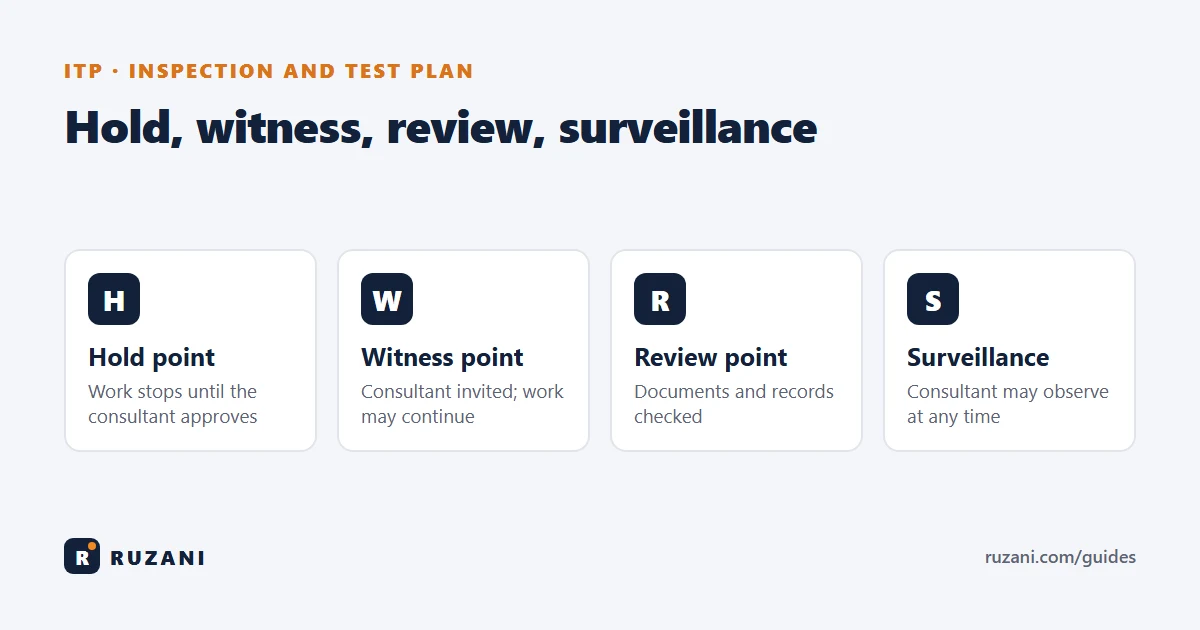
Short answer: an ITP (Inspection and Test Plan) is a table that lists every inspection and test for one activity, the acceptance criteria, the reference document, how often each check is done, and who must be involved. The key part is the inspection type: a hold point (H) means work stops until the consultant inspects and approves; a witness point (W) means the consultant is invited but work may continue if they don't attend; a review point (R) means documents are checked, with no site attendance.
What an ITP is
An Inspection and Test Plan is prepared by the contractor for each main activity (earthworks, concrete, blockwork, waterproofing, plumbing, electrical and so on) and approved by the consultant before the activity starts. It turns the specification into a checklist with clear responsibilities.
The ITP answers five questions for every check: What is checked? Against what (drawing, specification clause, standard)? How often? What is acceptable? And who must be there?
The ITP sits between the method statement (how the work is done) and the WIR (the request to inspect it). See the full order in QA/QC documents in construction.
Hold, witness, review and surveillance points
| Code | Type | What it means | Typical example |
|---|---|---|---|
| H | Hold point | Work must stop. It cannot continue until the consultant has inspected and approved. | Rebar and formwork before a concrete pour. |
| W | Witness point | The consultant is notified and may attend. If they don't come after proper notice, work may proceed. | Concrete pouring, a pipe pressure test, compaction tests. |
| R | Review point | Records or documents are reviewed. No physical attendance needed. | Mill certificates, batch tickets, calibration certificates. |
| S / M | Surveillance / monitor | The consultant may observe at any time during the activity, without a fixed point. | General workmanship during blockwork. |
| I / T | Inspection / test | Used on some ITPs to show whether the step is an inspection or a test. | Visual check vs lab test. |
There is no single world standard for these letters. Each project defines its own legend, usually on the ITP itself. Some Saudi project ITP templates also state a minimum notice period before a hold point, for example 24 hours, or longer for client inspections, as set in the contract.
Choosing the right point: use hold points for steps that cannot be checked later or are expensive to undo (anything that gets covered). Use witness points for tests that need observing. Too many hold points slow the job; too few leave quality gaps.
ITP format: the columns
Most ITPs are a table with these columns:
- Item / step number
- Activity or inspection, e.g. "Rebar size, spacing and cover"
- Reference document: drawing, specification clause, standard
- Acceptance criteria: e.g. "Cover 75 mm, tolerance −0 / +10 mm"
- Frequency: each pour, each 100 m³, each delivery
- Verifying record: checklist, test report, WIR
- Responsibility: contractor QC, consultant, third-party lab, client, with the H / W / R code for each
Worked example: concrete footing ITP
A simplified ITP for an isolated reinforced concrete footing. Your acceptance criteria will come from your own drawings and specification.
| # | Inspection / test | Criteria / reference | Frequency | Contractor | Consultant |
|---|---|---|---|---|---|
| 1 | Excavation level and dimensions | Drawing, survey | Each footing | I | H |
| 2 | Subgrade compaction test | Specification (e.g. ≥ 95% of max. dry density, ASTM D1557) | As per spec | T | W |
| 3 | Blinding concrete and waterproofing / polythene | Drawing, approved MAR | Each footing | I | W |
| 4 | Rebar size, spacing, laps, cover, starter bars | Structural drawing, specification | Each footing | I | H |
| 5 | Formwork dimensions, alignment, cleanliness | Drawing | Each footing | I | H |
| 6 | Concrete delivery tickets, mix approval | Approved mix design | Each truck | R | R |
| 7 | Slump / temperature test, sampling cubes or cylinders | Specification, ASTM / BS EN | As per spec | T | W |
| 8 | Curing | Specification | Daily | I | S |
| 9 | Compressive strength results (7 and 28 days) | Specification | Each set | R | R |
Steps 1, 4 and 5 are hold points: each needs an approved WIR before the next step starts. In practice, rebar and formwork are often inspected together on one pre-pour WIR.
How the ITP connects to WIRs
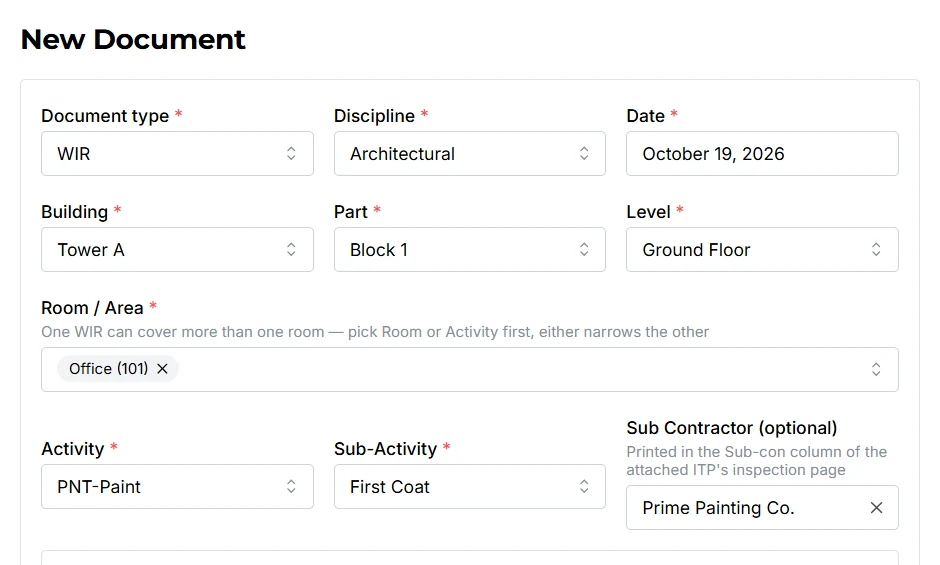
Every hold point needs a WIR. Most witness points also get a WIR or a notification. The WIR form normally has a field for the ITP reference and the ITP step, and the checklist attached to the WIR comes from the ITP. Material checks in the ITP connect to the MAR and MIR.
When the ITP and the WIR register are linked, you can see at a glance which hold points are done for each area. That is one of the things ADoc Flow does automatically: it attaches the right ITP page to each WIR.
Common ITP mistakes
- Copying a generic ITP without checking the project specification's tests and frequencies.
- No acceptance criteria, only "as per drawing". Give numbers and tolerances where you can.
- Every step a hold point, which delays the site and annoys everyone.
- Missing test frequencies, so nobody knows how many cubes or compaction tests are needed.
- ITP not approved before work starts, so WIRs have nothing to refer to.
When an inspection fails, the result is usually a rejected WIR or an NCR.
Preparing for a QA/QC interview? Practise with our 40 QA/QC engineer interview questions and answers.
FAQ
What is the full form of ITP in construction?
ITP stands for Inspection and Test Plan. It lists all inspections and tests for an activity, with criteria, frequency and who must be involved.
What is the difference between a hold point and a witness point?
At a hold point work must stop until the consultant inspects and approves. At a witness point the consultant is invited, but work may continue if they don't attend after proper notice.
What is a review point in an ITP?
A review point means only documents or records are checked, such as certificates or test reports. No site attendance is needed.
Who prepares and approves the ITP?
The contractor's QA/QC team prepares the ITP and the consultant approves it before the activity starts. Sometimes the client also marks its own hold points.
Is a WIR needed for every ITP step?
A WIR is needed for every hold point, and usually for witness points. Review points are covered by submitting the records.