Short answer: the full form of MIR is Material Inspection Request. An MIR is the form a contractor submits to the consultant when materials arrive on site, asking them to inspect the delivery before it is used in the works. The consultant checks that the delivered material is the same as the approved material (MAR), in the right quantity and condition, with valid test certificates, and returns the MIR as approved or rejected.
MIR meaning and why it matters
MIR stands for Material Inspection Request. On some projects you will also see Material Receiving Inspection Report (MRIR), Material Delivery Inspection or simply Material Inspection. They all describe the same step: checking materials when they reach site.
Before a material can be ordered, it must be approved through a Material Approval Request (MAR). But approval on paper is not enough. The consultant also wants proof that what actually arrived on the truck is the same product, from the same manufacturer, to the same specification that was approved. That proof is the MIR.
An approved MIR does three jobs:
- Quality: wrong, damaged or expired material is stopped at the gate, before it is built into the works.
- Traceability: every batch used on the project can be traced back to its delivery note and test certificate.
- Payment: on many contracts, an approved MIR is the supporting document the contractor needs to be paid for materials delivered and stored on site in the interim payment.
How the MIR process works
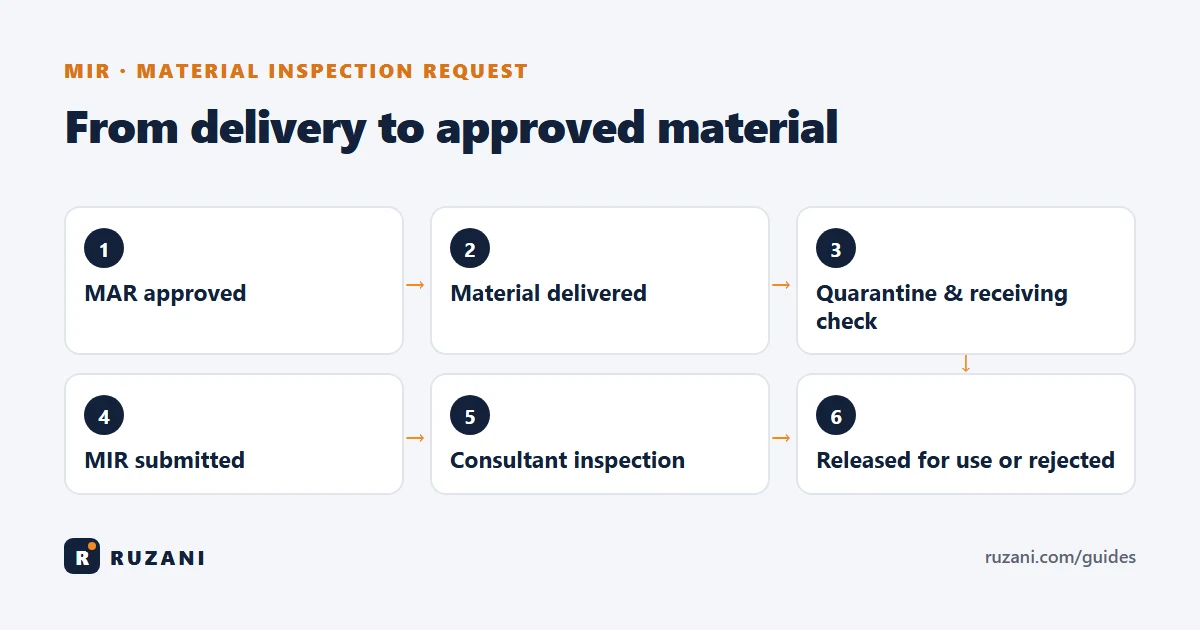
Every project has its own procedure, but the flow is usually the same:
- MAR approved first. The material has an approved MAR (status A or B). Without it, an MIR should not be raised.
- Material delivered. The supplier delivers with a delivery note, packing list and the mill or test certificates for that batch.
- Internal receiving check. The contractor's storekeeper and QC engineer check quantity, condition and documents, and keep the material in a quarantine area until it is inspected.
- MIR raised and submitted. The QC engineer fills in the MIR, gives it the next number, attaches the documents and submits it within the notice period, often 24 hours before the inspection.
- Joint inspection. The consultant's inspector checks the material on site against the approved MAR and the specification.
- Status returned. The MIR comes back approved, approved with comments, or rejected.
- Release or remove. Approved material is released for use and stored properly. Rejected material is tagged, kept apart and removed from site.
Tip: never let material go from the truck straight into the works. Keep a marked quarantine area. If material is used before the MIR is approved, the consultant can ask for it to be removed, even if it turns out to be good.
What an MIR format contains
Every consultant has their own MIR layout, but almost every one has the same building blocks:
| Section | What to fill in |
|---|---|
| MIR number and date | A unique number from the project numbering system, for example PRJ-MIR-B1-0032, and the submission date. |
| Project details | Project name, contract number, client, consultant and contractor. |
| Discipline | Civil, architectural, mechanical, electrical, plumbing, landscape and so on. |
| Material description | Exactly as on the approved MAR: product name, type, size, grade or class. |
| MAR reference | The approved MAR number and its approval status. |
| Manufacturer, supplier, origin | Must match the approved MAR. A different country of origin is a common rejection reason. |
| Quantity | Quantity delivered, unit of measure, and the delivery note number. |
| Storage location | Where the material is kept on site, and the storage condition (covered, off the ground, temperature). |
| Where it will be used | Building, area or element the material is for. |
| Attachments | Delivery note, packing list, test or mill certificates, approved MAR copy, photos. |
| Consultant's result | Approved, approved with comments, or rejected, with comments, name, signature and date. |
The MIR inspection checklist
When the inspector arrives, they normally check the following. Do the same check yourself before you call them.
- Identity: brand, product name and model match the approved MAR and data sheet.
- Quantity: matches the delivery note and the MIR.
- Condition: no damage, rust, cracks, wet bags or broken packaging.
- Marking and labels: batch numbers, heat numbers (for steel) and labels are readable and match the certificates.
- Certificates: mill certificates or test reports belong to this batch, not a different one.
- Shelf life: products like cement, adhesives, sealants and paints are within their expiry date.
- Storage: the material is stored as the manufacturer requires.
Some materials also need samples taken for testing at an approved lab, for example rebar tensile tests or block compressive strength tests. The ITP for that activity says which tests are needed and how often. See our guide to the Inspection and Test Plan (ITP).
MIR vs MAR vs WIR
These three documents are easy to mix up. They happen in this order:
| MAR | MIR | WIR | |
|---|---|---|---|
| Full form | Material Approval Request | Material Inspection Request | Work Inspection Request |
| When | Before ordering | When material arrives on site | When work is finished, before it is covered |
| Question it answers | "May we use this product?" | "Is this delivery the approved product, in good condition?" | "Is the installed work correct?" |
| Main attachments | Data sheets, certificates, samples, compliance statement | Delivery note, batch certificates, photos | Drawing, ITP checklist, survey, photos |
Read more in our WIR guide and our MAR guide, or see the full picture in QA/QC documents in construction.
Common reasons an MIR is rejected
- No approved MAR, or the MAR was approved with comments that the delivery does not meet.
- Different manufacturer or origin from the approved MAR.
- Certificates for the wrong batch, or copies that cannot be traced to the delivered material.
- Expired or damaged material, such as cement bags that got wet or adhesives past their shelf life.
- Material already used before the inspection.
- Quantity mismatch between the delivery note, the MIR and what is on the ground.
Keep an MIR register. Log every MIR with its number, material, MAR reference, quantity, status and date. It answers the consultant's and the quantity surveyor's questions in seconds, and it shows which deliveries still need inspection. Read how to keep a WIR and MIR register.
FAQ
What is the full form of MIR in construction?
MIR stands for Material Inspection Request. It is the request a contractor sends to the consultant to inspect materials delivered to site before they are used.
What is the difference between MIR and MAR?
A MAR (Material Approval Request) asks for approval of a product before it is ordered. An MIR (Material Inspection Request) asks the consultant to inspect the actual delivery on site and confirm it matches the approved MAR.
Who prepares the MIR?
The contractor's QA/QC engineer usually prepares and submits the MIR, with help from the storekeeper or procurement team for delivery notes and certificates. The consultant's inspector inspects and signs it.
When should an MIR be submitted?
As soon as the material is delivered and has passed the contractor's own receiving check, and before the material is used. Many projects ask for 24 hours' notice before the inspection.
Is an MIR needed for every delivery?
Usually yes, for every delivery of material that will become part of the permanent works. Some projects group small repeat deliveries; follow your project's quality plan.
Can material be used if the MIR is approved with comments?
Usually yes, as long as the comments are followed. If the comments ask for extra tests or documents, provide them before or as instructed.