Short answer: an NCR (Non-Conformance Report) records material or work that does not meet the approved drawings, specification, method statement or ITP. A good NCR states the requirement (with exact reference), the evidence of what was actually found (measured, located, photographed), and then tracks the correction, the root cause, the corrective action and the verification before it is closed.
When to raise an NCR (and when an SOR is enough)
An NCR is raised when something does not conform to a requirement and needs a formal decision. Typical triggers:
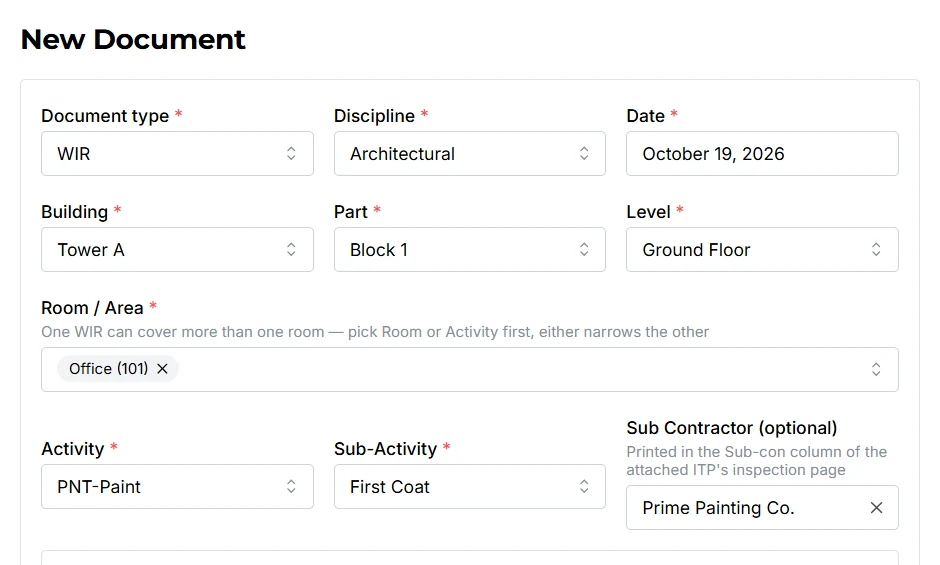
- Work covered or continued without an approved WIR at a hold point.
- Material used that is different from the approved MAR, or used before the MIR was approved.
- Failed tests, such as low concrete strength or failed compaction.
- Work outside tolerance: wrong levels, missing rebar, insufficient cover.
- A Site Observation Report (SOR) that was not closed in time.
An SOR (site observation) is for smaller issues that can be fixed quickly during normal work, such as housekeeping, a missing cover block found before the WIR, or minor finishing touch-ups. If it is not fixed, it can be raised to an NCR.
NCRs can be raised by the consultant against the contractor, or internally by the contractor's own QA/QC team. Internal NCRs are a sign of a healthy quality system, not a weak one.
What an NCR contains
| Field | What to write |
|---|---|
| NCR number, date | From the NCR log, e.g. PRJ-NCR-0018. |
| Location and activity | Building, level, grid lines, element. Precise enough that anyone can find it. |
| Requirement | What should have been done, with exact reference: drawing number and revision, specification clause, ITP step, approved MAR. |
| Non-conformance found | What was actually found: measured values, quantities, photos. |
| Severity | Minor / major / critical, if your project uses a classification. |
| Proposed disposition | Rework, repair, replace, or use as is (accept with concession), with the method. |
| Root cause | Why it happened. |
| Corrective / preventive action | What will stop it happening again. |
| Verification and close-out | Re-inspection result, WIR reference, signatures and closing date. |
How to write the description: requirement + evidence
A strong NCR is built on two parts, in this order:
- Requirement: quote what the document says, with its name, number, revision and clause. Anyone should be able to check it later.
- Evidence: state what you saw, as facts: where, what, how much, measured how. No opinions, no blame.
Test your NCR: could someone who was not on site understand exactly what is wrong, where, and against which requirement? If not, add detail.
Example: a bad NCR rewritten
Bad: "Poor rebar work in slab. Contractor to rectify."
The problem: no location, no requirement, no evidence, no measure of the problem. The contractor cannot respond properly and the consultant cannot verify the close-out.
Good:
- Location: Building B, Level 3 slab, between grids 4–6 / C–D.
- Requirement: Drawing S-B-L03-201 Rev C shows bottom bars T12 @ 150 mm both ways with 25 mm cover. ITP-CIV-004 step 4 is a hold point for rebar inspection.
- Evidence: On 26 Oct 2026, bottom bars were measured at 200–220 mm spacing over approx. 18 m² (6 bars missing in each direction). Cover blocks missing in the same area; measured cover 10–15 mm. Photos 1–4 attached. Concrete not yet poured.
- Disposition: Add missing bars and cover blocks as per drawing; re-inspect under WIR before pour.
Now everyone knows exactly what to fix, and the consultant can verify it with a single follow-up WIR.
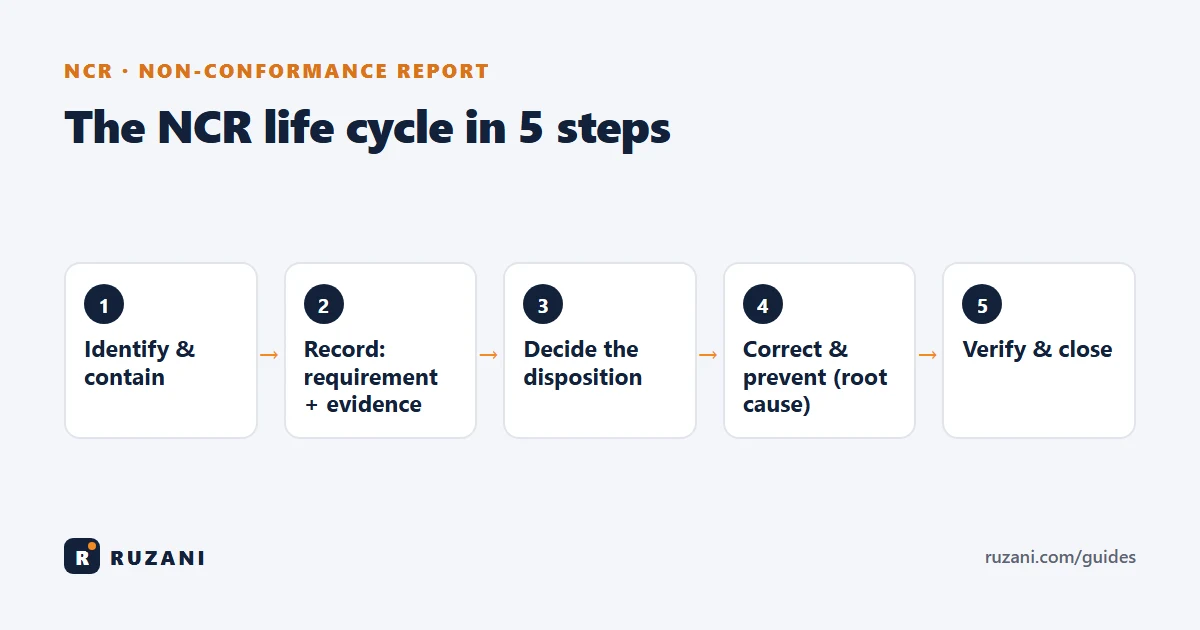
The NCR life cycle in 5 steps
- Identify and contain. Stop the affected work, tag or separate the material, and stop it from being covered.
- Record. Raise the NCR with requirement, evidence and photos, and log it in the NCR log.
- Decide the disposition. The contractor proposes rework, repair, replacement or use-as-is; the consultant (and designer, if needed) approves.
- Correct and prevent. Carry out the correction, then find the root cause (the "5 Whys" or a fishbone diagram) and agree a corrective action: training, a revised method statement, an extra checklist step, better supervision.
- Verify and close. Re-inspect (usually with a WIR), attach evidence, and the consultant signs the NCR as closed.
Note the difference: the correction fixes this defect; the corrective action stops it happening again. Both are needed.
Common NCR mistakes
- Vague descriptions without location, measurements or references.
- Blaming people instead of describing facts.
- Root cause = "carelessness". Ask why again until you reach something you can fix.
- Closing without verification or without evidence attached.
- NCRs left open for months. Review open NCRs every week; their age is a key quality KPI.
- Correction done, nothing learned, so the same NCR comes back on the next floor.
For how NCRs fit with the other documents, see QA/QC documents in construction. To prevent NCRs, make sure your ITP has clear acceptance criteria.
Preparing for a QA/QC interview? Practise with our 40 QA/QC engineer interview questions and answers.
FAQ
What is the full form of NCR in construction?
NCR stands for Non-Conformance Report. It records material or work that does not meet the contract requirements.
Who raises an NCR?
The consultant usually raises NCRs against the contractor, but the contractor's own QA/QC team can and should raise internal NCRs too.
What is the difference between NCR and SOR?
An SOR (Site Observation Report) records a minor issue that can be fixed quickly. An NCR is for a real non-conformance that needs a formal decision, root cause and close-out. An unresolved SOR can become an NCR.
What is the difference between correction and corrective action?
Correction fixes the defect itself. Corrective action removes the cause so the problem does not happen again.
What does "use as is" mean on an NCR?
The non-conforming item is accepted without repair because the designer or consultant confirms it is still fit for purpose. It must be approved in writing and recorded.