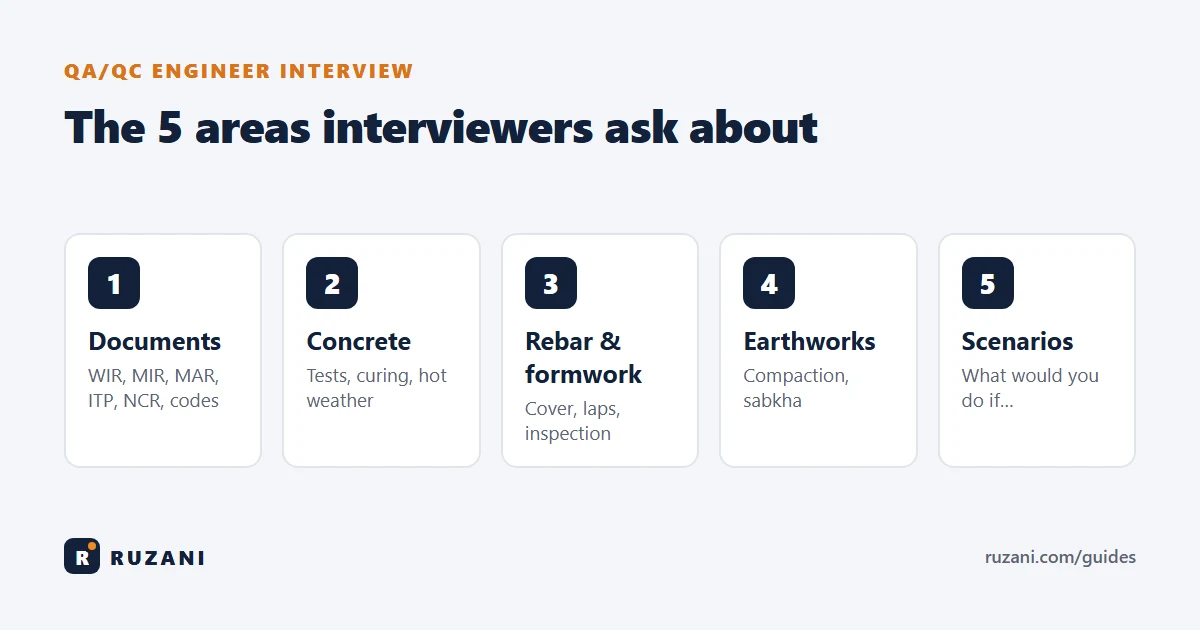
Short answer: QA/QC civil engineer interviews in Saudi Arabia and the Gulf usually cover five areas: QA/QC documents (WIR, MIR, MAR, ITP, NCR), concrete (tests, curing, hot weather), reinforcement (cover, laps, inspection), earthworks (compaction tests, soil issues like sabkha), and scenario questions about what you would do when something goes wrong. Below are 40 common questions with short model answers you can adapt to your own experience.
Important: numbers below are typical values to show you understand the topic. In an interview, always add "as per the project specification". Interviewers like engineers who check the spec rather than quote from memory.
QA/QC documents and systems (1–10)
1. What is the difference between QA and QC?
QA (quality assurance) is planning and systems that prevent defects: the quality plan, procedures, ITPs, audits. QC (quality control) is checking the actual work and materials: inspections, tests, WIRs, MIRs.
2. What is a PQP?
The Project Quality Plan describes how quality is managed on the project: organisation, responsibilities, procedures, inspection and testing, document control, non-conformance and handover. It is usually based on ISO 9001.
3. What is a WIR and when do you raise it?
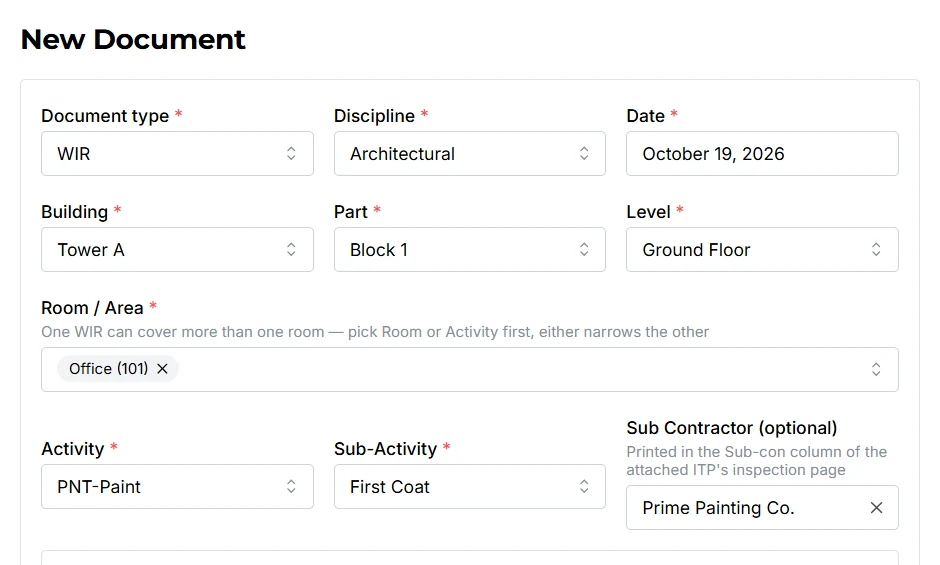
A Work Inspection Request asks the consultant to inspect completed work before it is covered, for example rebar before concrete. I raise it after my own internal inspection, with the drawing, ITP checklist and attachments. Full WIR guide.
4. Explain MAR and MIR.
MAR (Material Approval Request) approves a product before ordering. MIR (Material Inspection Request) inspects the delivery on site against the approved MAR. MIR guide.
5. What is an ITP?
An Inspection and Test Plan lists every inspection and test for an activity, with criteria, frequency, references and responsibilities. ITP guide.
6. Hold point vs witness point?
At a hold point work stops until the consultant approves. At a witness point the consultant is invited, and work may continue if they don't attend after proper notice.
7. What is an NCR and how do you close it?
A Non-Conformance Report records work or material that does not meet requirements. To close it: contain the problem, find the root cause, agree the correction (rework, repair, accept as is with approval), take corrective action to stop it happening again, and get the consultant's verification. NCR guide.
8. What do approval codes A, B, C, D mean?
Commonly: A approved, B approved as noted, C revise and resubmit, D rejected. The exact meaning is in the project specification. Codes explained.
9. What is a method statement?
A step-by-step description of how an activity will be done safely and correctly: sequence, resources, equipment, quality checks and risk controls. Method statement format.
10. Which codes and standards have you worked with?
Answer honestly. On Saudi projects, mention the Saudi Building Code (SBC, for example SBC 304 for concrete), plus ACI, ASTM and BS EN standards as referenced in the specification.
Concrete (11–20)
11. What do you check before a concrete pour?
Approved WIR for rebar and formwork, cover blocks, cleanliness, embedded items and sleeves, approved mix design, pump and vibrators ready, curing materials ready, weather conditions, and the testing team for slump and samples.
12. What tests are done on fresh concrete?
Slump (ASTM C143 or BS EN 12350-2), concrete temperature, and sampling for cubes or cylinders. Some projects add air content or unit weight.
13. Cube vs cylinder test?
Cubes (usually 150 mm) follow BS EN practice; cylinders (usually 150 × 300 mm) follow ASTM C39. Cylinder strength is lower than cube strength for the same concrete, so always compare with the right specified value.
14. When is concrete strength tested?
Usually at 7 days to monitor early strength and 28 days for acceptance, unless the specification says otherwise.
15. What if 28-day results are below the specified strength?
Report it, raise an NCR if required, check the testing records, and with the consultant's agreement investigate further, for example with core tests or non-destructive tests, before deciding on acceptance or repair.
16. What is hot weather concreting and what precautions do you take?
High temperatures speed up setting and cause cracking. Precautions: chilled water or ice, pouring at night or early morning, shading, limiting concrete temperature as specified, quick placing, and immediate curing. ACI 305 gives guidance.
17. How long should concrete be cured?
As per specification, commonly at least 7 days of moist curing or a curing compound, longer for some cements or hot climates.
18. What causes honeycombing and how is it repaired?
Poor vibration, congested rebar, mix segregation or leaking formwork. Minor honeycombing is cleaned back to sound concrete and repaired with approved repair mortar; major honeycombing needs an NCR and an engineer's repair method.
19. What is a cold joint?
A joint formed when fresh concrete is placed against concrete that has already started to set, because of a delay. It can be a weak plane and a leak path. Planned construction joints are prepared and approved; unplanned cold joints are reported.
20. What is the water-cement ratio and why does it matter?
The ratio of water to cement by weight. A higher ratio means lower strength and durability. Adding water on site to improve workability is not allowed; use approved admixtures instead.
Reinforcement and formwork (21–26)
21. What do you check in a rebar inspection?
Bar sizes, number and spacing, laps and their location, anchorage and bends, cover and cover blocks, chairs, starter bars, cleanliness (no oil, loose rust or mud), and tying. Compare everything with the approved shop drawing.
22. What concrete cover is required?
As shown on the structural drawings and specification. As an example, ACI 318 requires 75 mm for concrete cast against and permanently exposed to earth.
23. How long is a lap splice?
As shown on the drawings or calculated by the designer; it depends on bar size, concrete strength and position. Many drawings show around 40–50 bar diameters, but the drawing is what counts.
24. What tests are done on rebar?
Review of mill certificates for each heat number, and sampling for tensile, bend and weight tests at an approved lab at the frequency in the specification.
25. What do you check in formwork?
Dimensions, levels, alignment, plumbness, rigidity and propping, tight joints, cleanliness, release agent, and openings or embedded items.
26. When can formwork be removed?
When the concrete has enough strength, as per the specification or the formwork design. Soffits of slabs and beams need longer than vertical faces.
Earthworks and soil (27–31)
27. How is compaction checked?
Field density tests (sand cone, ASTM D1556, or nuclear gauge, ASTM D6938) compared with the maximum dry density from a Proctor test (often Modified Proctor, ASTM D1557). Many specifications require 95% or more.
28. What is the optimum moisture content?
The moisture content at which the soil reaches its maximum dry density in the Proctor test. Fill is compacted close to it.
29. What is sabkha and why does it matter?
Sabkha is salt-rich, often weak soil found in coastal and low-lying areas of the Gulf. It can lose strength when wet and attack concrete and steel with salts. Common measures are soil replacement, geotextiles, sulfate-resistant concrete and extra waterproofing, as the geotechnical report recommends.
30. What is a plate load test?
A field test that loads a steel plate on the soil to measure bearing capacity and settlement.
31. What do you check before backfilling?
Approved WIR for the structure below (waterproofing, protection board), approved fill material, layer thickness, moisture, and the compaction testing plan.
Waterproofing, blockwork and MEP basics (32–35)
32. How do you test waterproofing on a roof or wet area?
A flood test: block the drains, fill with water, and check for leaks after the period in the specification, often 24 to 48 hours.
33. What do you check in blockwork?
Approved blocks (MAR / MIR), line, level and plumb, mortar joints, bonding, wall ties to columns, lintels over openings, and movement joints.
34. How are water pipes tested?
A hydrostatic pressure test, usually at 1.5 times the working pressure or as specified, held for the specified time with no pressure drop.
35. What is a third-party inspection?
An inspection or test by an independent, approved lab or agency, for example concrete testing labs, welding inspection or lifting equipment certification.
Scenario questions (36–40)
36. The site engineer wants to pour concrete before the WIR is approved. What do you do?
Explain politely that rebar is a hold point and cannot be covered without approval. Escalate to the project manager if needed. If concrete is poured anyway, report it; the consultant can ask for the work to be broken out.
37. The consultant rejects your WIR. What next?
Read the comments, correct the defects, re-inspect internally, and resubmit (often as a new revision of the same WIR). Record it in the register.
38. A delivery arrives with certificates for a different batch.
Keep the material in quarantine, ask the supplier for the correct certificates, and do not use it until the MIR is approved.
39. How do you prevent the same NCR from repeating?
Find the real root cause (5 Whys or a fishbone diagram), fix the system (training, method statement, checklist, supervision), and check that it works.
40. How do you keep track of hundreds of inspections?
With registers for WIR, MIR, MAR and NCR, updated every day, reviewed weekly, with open items followed up. Many teams now use software so the registers update themselves. Excel vs software.
How to prepare
- Read the documents chain in QA/QC documents in construction until you can explain it without notes.
- Prepare two or three real stories: a defect you found, an NCR you closed, a problem you solved.
- Bring examples of your WIRs, checklists or registers (without confidential details).
- Download our free QA/QC ebook: the Complete edition has a 25-question quiz, a cheat sheet and CV and interview tips.
FAQ
What questions are asked in a QA/QC civil engineer interview?
Mostly about QA/QC documents (WIR, MIR, MAR, ITP, NCR), concrete testing and curing, rebar inspection, compaction tests, waterproofing, and scenario questions about non-conformances and rejected inspections.
Which standards should a QA/QC engineer in Saudi Arabia know?
The Saudi Building Code (SBC), plus the ACI, ASTM and BS EN standards referenced in the project specification, and ISO 9001 for quality management.
How do I answer "What will you do if work fails inspection?"
Explain the steps: stop, record, correct, re-inspect internally, resubmit, and raise an NCR if it is a real non-conformance, then find the root cause so it does not happen again.
Do I need a certification to become a QA/QC engineer?
Not always, but certificates such as ISO 9001 lead auditor, or Saudi Council of Engineers registration where required, help you stand out. Experience with real QA/QC documents matters most.