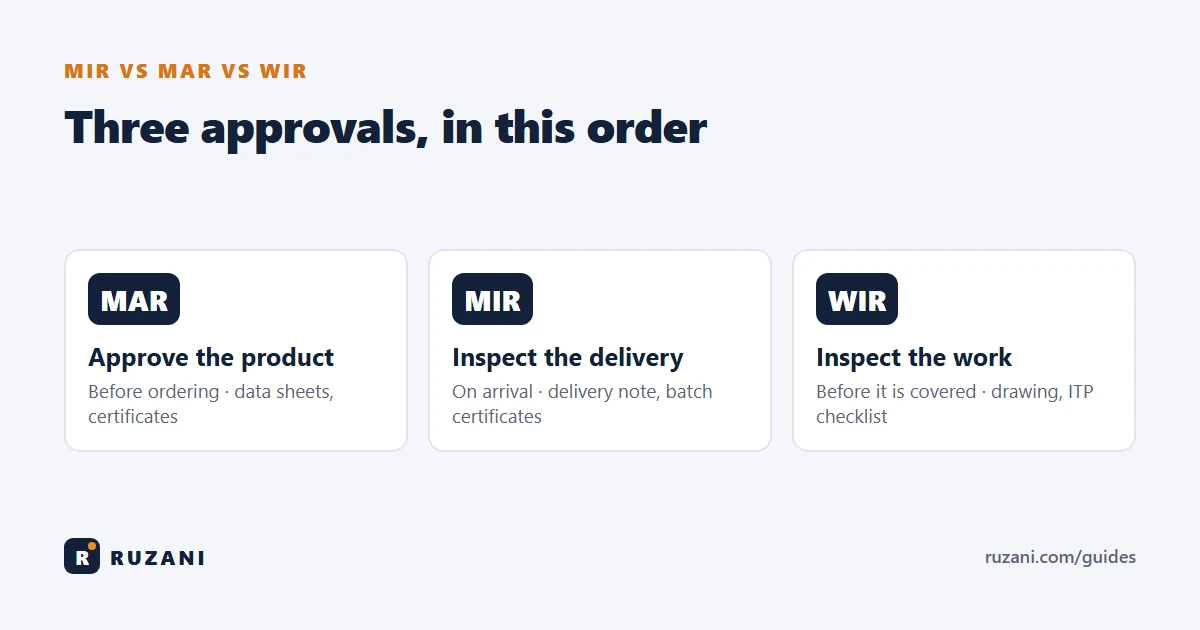
Short answer: the MAR (Material Approval Request) approves a product before it is ordered. The MIR (Material Inspection Request) inspects the delivery when it arrives on site. The WIR (Work Inspection Request) inspects the installed work before it is covered. They always happen in that order: MAR → MIR → WIR.
MAR vs MIR vs WIR in one table
| MAR | MIR | WIR | |
|---|---|---|---|
| Full form | Material Approval Request | Material Inspection Request | Work Inspection Request |
| Question it answers | May we use this product? | Is this delivery the approved product, in good condition? | Is the installed work correct? |
| When | Before ordering | When material reaches site, before use | When work is finished, before it is covered |
| Checked against | Specification | Approved MAR, delivery documents | Approved drawings, ITP, method statement |
| Main attachments | Data sheets, test certificates, compliance statement, samples | Delivery note, batch certificates, photos | Marked-up drawing, ITP checklist, test results |
| Reviewed where | In the office (document review) | On site, at the store or laydown area | On site, at the work location |
| Result | Code A / B / C / D | Approved / with comments / rejected | Code A / B / C / D |
| Full guide | MAR guide | MIR guide | WIR guide |
One example from start to finish: floor tiles
- MAR: the contractor proposes a specific porcelain tile with its data sheet, slip-resistance and water-absorption test reports, a compliance statement and a sample board. The consultant returns Code B: "approved, colour to match sample 2".
- Order: the tiles are ordered in colour 2 only after the approval.
- MIR: the delivery arrives. The QC engineer checks the brand, model, colour, batch, quantity and certificates against the approved MAR, and raises the MIR. The consultant inspects and approves.
- Installation: the tiles are laid as per the method statement.
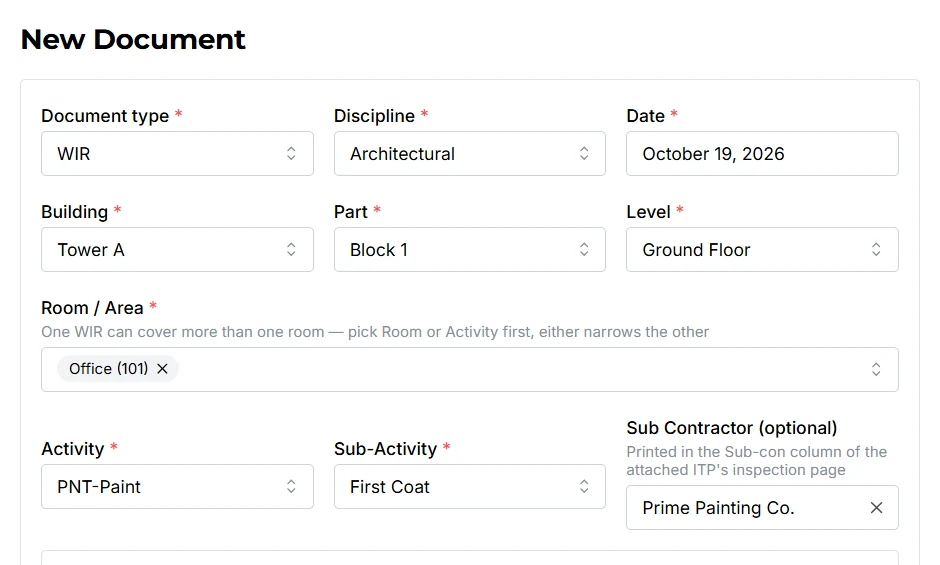
- WIR: the finished floor is offered for inspection: levels, joints, pattern, hollowness. The consultant approves, and the next activity can start.
How the three documents connect
- An MIR always quotes its approved MAR number. No approved MAR, no MIR.
- A WIR often quotes the MIR (or MAR) of the materials used, so the inspector can see the materials were accepted.
- All three are numbered and tracked in registers. See approval codes A, B, C, D and the free registers workbook.
The full order of all QA/QC documents is in QA/QC documents in construction.
Common mix-ups
- Raising an MIR for a product that was never approved. The MIR will be rejected; raise the MAR first.
- Using a WIR to "approve" materials that were never inspected on delivery.
- Ordering on a Code C MAR because "it's nearly approved".
- Calling everything an "inspection" in the register, so nobody can tell which materials are approved.
FAQ
What is the difference between MAR and MIR?
The MAR approves a product before it is ordered. The MIR inspects the actual delivery on site and confirms it matches the approved MAR.
What is the difference between MIR and WIR?
An MIR checks materials when they are delivered. A WIR checks the installed work before it is covered by the next activity.
Which comes first, MAR or MIR?
The MAR always comes first. The MIR refers to the approved MAR number.
Do all three use the same status codes?
On many Gulf projects, yes: A approved, B approved with comments, C revise and resubmit, D rejected. Check your project's specification.