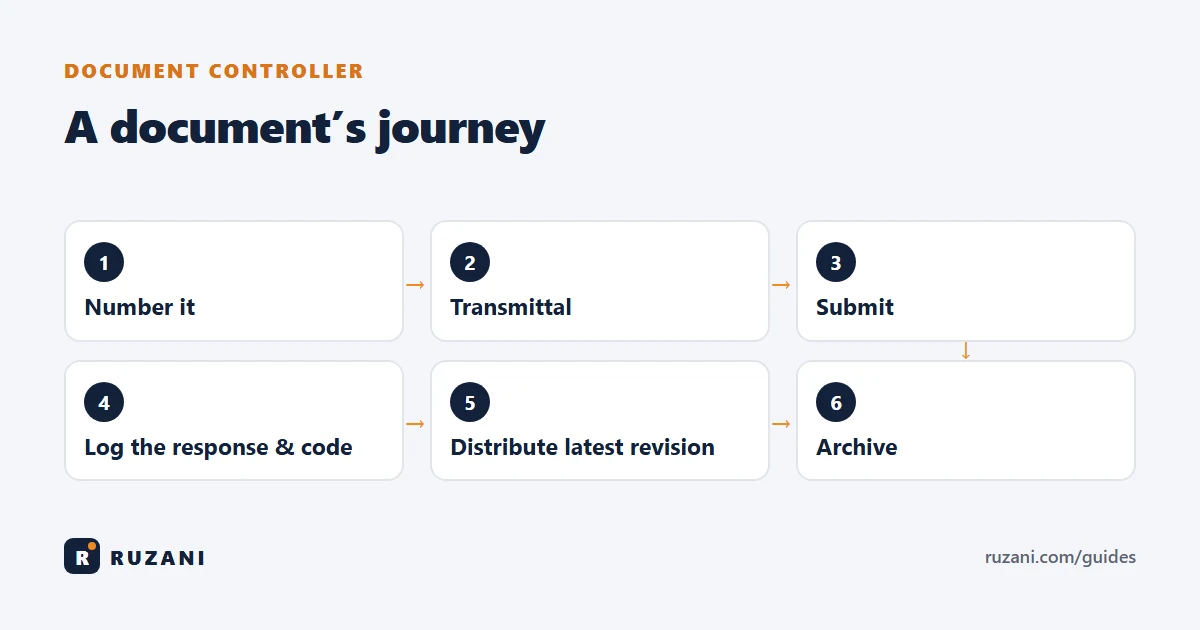
Short answer: a document controller on a construction project makes sure every document is numbered, submitted, tracked, distributed and filed correctly, and that only the latest approved revision is used on site. Daily work includes preparing transmittals, logging submittals (MAR, shop drawings, WIR, MIR, RFI, NCR) in registers, recording the consultant's status codes, withdrawing superseded drawings, and sending weekly status reports to the project manager.
What the role is about
A construction project produces thousands of documents: drawings, submittals, inspection requests, letters, minutes, reports. If a site team builds from an old drawing revision, or a WIR is lost, the cost can be huge. The document controller is the person who prevents that. It is a quiet job when done well, and the whole project notices when it is not.
Document controllers work closely with the QA/QC team, the technical office and the project manager. On the contractor's side they handle outgoing submittals and incoming responses; on the consultant's side they handle the reverse.
Daily and weekly duties
- Numbering every new document according to the project's numbering procedure.
- Transmittals: preparing a transmittal for every formal submission, and logging signed acknowledgements.
- Submitting through the project system (Aconex, email or hard copy, as agreed).
- Logging responses: recording the consultant's status code, comments and date for every returned document. See approval codes A, B, C, D.
- Revision control: making sure only the latest approved drawings are on site, stamping superseded copies and withdrawing them.
- Distribution: sending approved documents to the right people according to the distribution matrix.
- Follow-up: chasing overdue reviews and open items.
- Filing and archiving, both electronic and paper, ready for audits and the final handover.
- Reporting: weekly status reports and registers for the project manager and meetings.
The registers a document controller keeps
| Register | Tracks |
|---|---|
| Master document register | Every project document with number, title, revision and status. |
| Drawing register | Design and shop drawings, current revision, status, issue dates. |
| MAR register | Material submittals and their approval status. About MARs. |
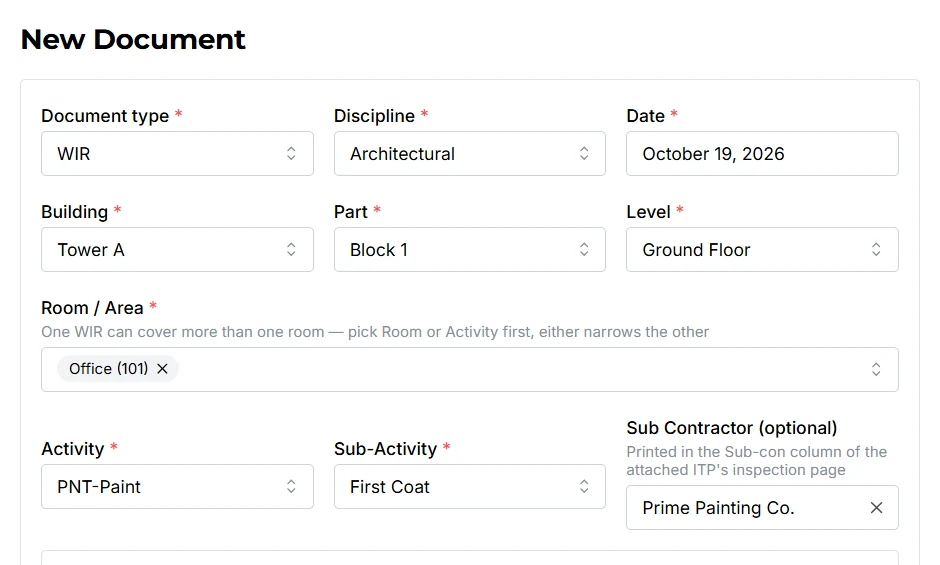
| WIR register | Every work inspection, location, activity, date, result. About WIRs. |
| MIR register | Every material delivery inspection. About MIRs. |
| RFI log | Technical questions and answers. |
| NCR / SOR log | Non-conformances and observations, open and closed. About NCRs. |
| Transmittal log | Everything sent and received, with dates. |
| Correspondence register | Letters and site instructions. |
Every register should at least have: number, revision, title or description, date submitted, date returned, status code, and remarks. For the QA/QC registers, add location (building, level, area) and discipline so you can filter quickly.
Document numbering
Most projects use a structured number, for example PRJ-WIR-B2-0147: project code, document type, building or area, then a running serial number. Revisions are added as Rev 00, Rev 01 or Rev A, Rev B. The rules are set in the project's document control procedure. The two classic problems are duplicate numbers (two people take the "next number" at the same time) and skipped numbers. A single shared system that hands out numbers avoids both.
The weekly status report
Project managers want answers, not raw registers. A useful weekly report has:
- Summary per document type: submitted this week, approved, under review, Code C / D, overdue.
- Overdue list: documents with the consultant longer than the contract review period.
- Open NCRs with their age.
- Upcoming submissions needed for the next activities.
Tools: Aconex, Excel and others
Large projects in Saudi Arabia and the Gulf often use Oracle Aconex as the common platform between client, consultant and contractor, and job adverts often ask for Aconex experience. Other platforms include Procore, Autodesk Construction Cloud, ProjectWise and SharePoint.
Inside the contractor's own team, though, most registers still live in Excel. It is flexible and everyone knows it, but on busy projects it becomes slow and error-prone: several copies, manual status updates, duplicate numbers. We compare the options in WIR and MIR registers: Excel vs software.
Tools like ADoc Flow sit in between: they prepare the WIR, MAR and MIR on the consultant's own form, number them, and keep every register up to date automatically, while the final documents can still be submitted through Aconex or email.
Skills employers ask for
- Strong Excel skills (filters, pivot tables, lookups).
- Experience with Aconex or a similar document management system.
- Understanding of QA/QC documents and approval codes. Start with QA/QC documents in construction.
- Attention to detail, organisation, and clear written English.
- Several years of document control experience on construction or infrastructure projects for senior roles.
FAQ
What does a document controller do in construction?
They number, submit, track, distribute and file project documents, keep the registers, control revisions so only the latest approved documents are used, and report document status to the project manager.
What is a transmittal?
A cover sheet that formally records which documents were sent, to whom, when, for what purpose (approval, information), and is signed or acknowledged on receipt.
Which software do document controllers use?
Aconex is common on large Gulf projects, along with Procore, ProjectWise, SharePoint and, very often, Excel for internal registers.
Is document controller a good career in Saudi Arabia?
Yes, document controllers are needed on every major project. Experience with Aconex, QA/QC documents and strong Excel skills makes candidates much more competitive.
What is the difference between a document controller and a QA/QC engineer?
The QA/QC engineer prepares and inspects the technical content (WIRs, MIRs, NCRs). The document controller manages the numbering, submission, tracking and filing of those documents.