Short answer: the main QA/QC documents in construction are the Project Quality Plan (PQP), method statements, Inspection and Test Plans (ITP), Material Approval Requests (MAR), Material Inspection Requests (MIR), Work Inspection Requests (WIR), Non-Conformance Reports (NCR), Site Observation Reports (SOR), test reports, and the registers that track them all. Together they prove that every material and every piece of work was approved, inspected and accepted.
The QA/QC document flow, in order
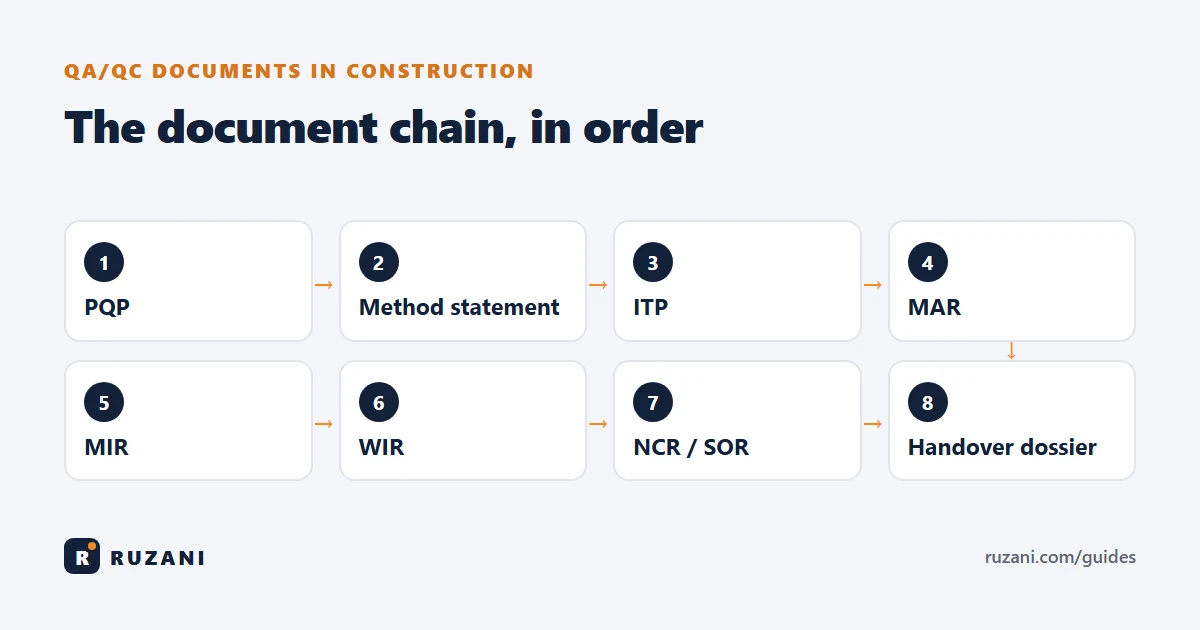
New QC engineers often learn the documents one by one and miss how they connect. On a real project they follow a clear order. Each document depends on the one before it:
- Project Quality Plan (PQP): how quality will be managed on the whole project.
- Method statement: how one activity will be done, safely and correctly.
- Inspection and Test Plan (ITP): what will be checked and tested for that activity, and by whom.
- Material Approval Request (MAR): approval of each product before ordering.
- Material Inspection Request (MIR): inspection of each delivery when it reaches site.
- Work Inspection Request (WIR): inspection of each completed piece of work before it is covered.
- NCR / SOR: recording and fixing anything that does not comply.
- Handover documents: the quality dossier, test records and as-built records at the end.
Remember the chain: no WIR without an approved ITP and method statement, and no MIR without an approved MAR. When a consultant rejects a document, the reason is very often a missing or unapproved document earlier in the chain.
Planning documents
Project Quality Plan (PQP)
The PQP is the contractor's master quality document. It describes the quality organisation, responsibilities, procedures for document control, inspection, testing, non-conformance, audits and handover. It is submitted at the start of the project and approved by the consultant. Most PQPs follow the structure of ISO 9001.
Method statement (MS)
A method statement explains, step by step, how a specific activity will be carried out: the sequence, equipment, materials, manpower, safety measures and the quality checks. In the Gulf, a method statement is usually submitted together with a risk assessment and a job safety analysis. Read our guide to the method statement format.
Inspection and Test Plan (ITP)
The ITP lists every inspection and test for an activity, the acceptance criteria, the reference standard, how often each check is done, and the type of involvement for each party: hold, witness, review or surveillance. The ITP decides which steps need a WIR. Read the full ITP guide.
Shop drawings
Detailed drawings prepared by the contractor or a specialist subcontractor to show exactly how something will be built or installed. They are submitted for approval like a MAR, with status codes.
Material documents
Pre-qualification of suppliers and subcontractors
Before materials are submitted, suppliers and specialist subcontractors are often pre-qualified: company profile, experience, certificates and past projects.
Material Approval Request (MAR)
The MAR asks the consultant to approve a specific product before it is ordered. It includes data sheets, test certificates, a compliance statement against the specification, and samples where needed. Read the full MAR guide.
Material Inspection Request (MIR)
When the material arrives, the MIR asks the consultant to inspect the delivery and confirm it matches the approved MAR. Read the full MIR guide.
Work inspection documents
Work Inspection Request (WIR)
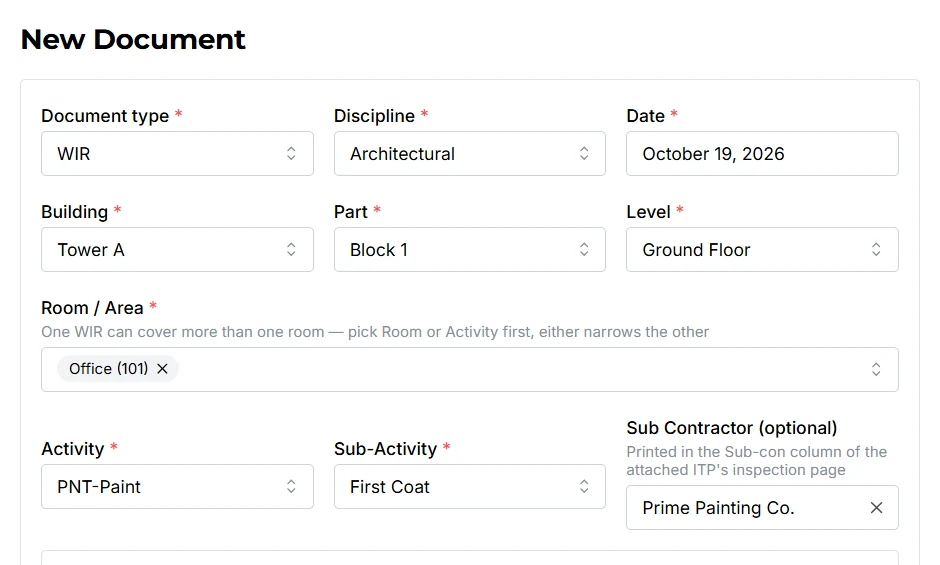
The WIR asks the consultant to inspect completed work before the next activity covers it, for example rebar before concrete. It refers to the drawing, the ITP and the method statement. Read the full WIR guide.
Checklists
Each WIR is backed by a checklist from the ITP: pre-pour checklist, blockwork checklist, waterproofing checklist and so on. The contractor's QC engineer completes it before calling the consultant.
Test reports
Results from site and lab tests: concrete cube or cylinder tests, slump, soil compaction, pressure tests for pipes, insulation resistance tests for cables and so on. They are attached to the WIR or MIR they belong to.
Request for Information (RFI)
An RFI is a question to the designer or consultant when drawings or specifications are unclear or conflict. Watch out: on some projects "RFI" means Request for Inspection, which is the same as a WIR. Check your project's document procedure.
When something goes wrong
Non-Conformance Report (NCR)
An NCR records work or material that does not meet the drawings, specification or approved documents. It needs a root cause, a correction, a corrective action, and verification before it is closed. Read how to write an NCR.
Site Observation Report (SOR)
An SOR (or site instruction / observation) records a smaller quality issue seen during a site visit that needs attention but is not serious enough for an NCR. If it is not fixed, it can become an NCR.
Corrective Action Request (CAR)
Used on some projects for repeated or system problems, asking for a change in the procedure itself, not just a repair.
Registers and reports
Every document above is numbered and logged in a register: WIR register, MIR register, MAR register, NCR log, RFI log, drawing register and so on. Registers show the status of every document at a glance and are what the project manager and consultant ask for in weekly meetings. Status is usually shown with the consultant's approval codes; see approval codes A, B, C, D explained.
The person who runs this system day to day is the document controller, together with the QA/QC team.
All QA/QC documents in one table
| Document | Purpose | Prepared by | Approved by |
|---|---|---|---|
| PQP | Overall quality system for the project | Contractor QA/QC manager | Consultant / client |
| Method statement | How an activity will be done | Contractor engineer | Consultant |
| ITP | What will be inspected and tested | Contractor QA/QC | Consultant |
| Shop drawing | Detailed construction drawing | Contractor / subcontractor | Consultant |
| MAR | Approve a product before ordering | Contractor QA/QC or technical office | Consultant |
| MIR | Inspect a delivery on site | Contractor QA/QC | Consultant inspector |
| WIR | Inspect completed work | Contractor QA/QC | Consultant inspector |
| Test report | Prove a test result | Lab / contractor | Reviewed by consultant |
| RFI | Ask a technical question | Contractor | Answered by consultant / designer |
| NCR | Record a non-conformance | Consultant or contractor QA/QC | Closed by consultant |
| SOR | Record a site observation | Consultant | Closed by consultant |
| Registers | Track status of all documents | Document controller / QA/QC | Reviewed in meetings |
Want all of this with diagrams, checklists and 8 ready templates? Download our free QA/QC in Construction ebook.
Preparing for a QA/QC interview? Practise with our 40 QA/QC engineer interview questions and answers.
FAQ
What are QA/QC documents in construction?
They are the plans, requests, reports and registers that prove materials and work meet the contract requirements: PQP, method statements, ITPs, MARs, MIRs, WIRs, test reports, NCRs, SORs, RFIs and the registers that track them.
What is the difference between QA and QC documents?
QA (quality assurance) documents plan how quality will be achieved, such as the PQP, procedures and ITPs. QC (quality control) documents record the actual checks, such as MIRs, WIRs, checklists, test reports and NCRs.
Which QA/QC document comes first on a project?
The Project Quality Plan comes first. Then method statements and ITPs for each activity, then material approvals (MAR), then material inspections (MIR) and work inspections (WIR) as the work progresses.
Who keeps the QA/QC documents?
The QA/QC team prepares them and the document controller numbers, submits, tracks and files them in registers and the project's document system.
Is RFI the same as WIR?
Not usually. An RFI is normally a Request for Information (a technical question). But some projects use RFI to mean Request for Inspection, which is the same as a WIR. Check your project's procedure.